
The 960th Quartermaster Service Company buried thousands of Americans killed in combat in Europe.
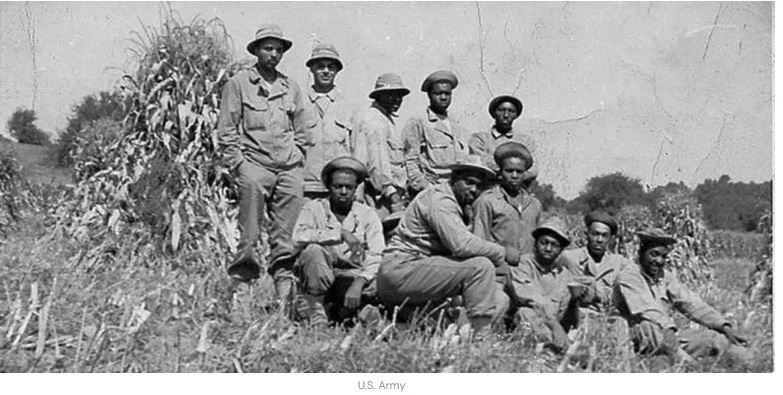
Army trucks arrived in droves, filled with bodies, and African American soldiers stood in the freezing mud ready to unload them. First Sergeant Jefferson Wiggins had relayed his orders to his men: Dig graves for all the corpses. Beyond the gruesomeness of the task was its irony. While burying white soldiers was allowed, serving with them alive wasn’t.
The 960th Quartermaster Service Company, a segregated unit of 260 Black G.I.s serving in World War II, was sent to Margraten, a village in the Netherlands, in the fall of 1944. As was the case for most Black divisions, the 960th QMSC was a service unit, not a combat one. But their service of digging graves—even in harsh winter conditions—for approximately 20,000 American soldiers who’d been killed in battle wasn’t officially recognized until nearly 65 years later. Initially reluctant to dredge up his painful war stories, Wiggins eventually did. “People should know about this,” Janice Wiggins recalled her late husband saying after decades without mentioning it
.
Journey to the Netherlands
More than 1.2 million Black soldiers served in World War II, primarily in divisions that provided supplies to white troops. Because the army adhered to the discriminatory policies of the United States, the military was segregated, with African American soldiers serving in separate units, living in segregated quarters and being relegated to mostly menial tasks.
The 960th Quartermaster Service Company was established as an all-Black division at Camp Phillips in Kansas in 1943. Captain William Solms, a white officer, oversaw the men but Jefferson Wiggins, the group’s First Sergeant, was Black and understood the weight of Jim Crow segregation. Originally from rural Alabama, where there were limited educational opportunities for African Americans and a looming threat of violence from the Ku Klux Klan, Wiggins decided to enlist.
“As an army volunteer you at least got enough to eat, three meals a day,” said Wiggins, in From Alabama to Margraten, the book about his life by oral historian and author Mieke Kirkels. “You could get good medical care, and with a bit of luck you’d be treated more respectfully than back home,” Wiggins said…
TO CONTINUE, READ MORE HERE

Alexis Clark writes about race, culture and politics during major events and eras in American history. She has written for The New York Times, Smithsonian, Preservation and other publications. She is the author of Enemies in Love: A German POW, A Black Nurse, and an Unlikely Romance, and an assistant professor at Columbia Journalism School.